
As Citylight readies to celebrate ten years as a church, I am writing a series of reflections. This is the fifth.
- Envisioning Citylight
- Enlarging our Family
- Catching First Wind
- Failing to Launch
- Finding our Voice
- Growing as Family
- Turning 10
It is often said, “Desperate times call for desperate measures.” However, desperation is not the best strategy for church planting (or really anything). Nevertheless, desperation can be a means in God’s sovereignty for inspiration and action. I was now desperate.
We had begun vision meetings on Thursday evenings in our home, but our home was now too cramped. We had tried to launch Sunday morning preview services in a city middle school, but the auditorium was too cavernous. We needed a space which suited our group size, our planting philosophy and our ministry budget. On June 29, 2008, I took us down by the river for outdoor worship and lunch fellowship at Wasena Park. This was a desperate action to keep this date which we had already announced, but even this was a means in God’s sovereignty to lead us. A lot of things in the Scripture get started by the river, such as Jesus’ ministry in Matthew 3 and the planting of the Philippian church in Acts 16, so perhaps we were onto something inadvertently.
At this same time, I also was hustling to find a venue for weekly worship and community. With several of our families living in southwest Roanoke city near Grandin Village, I narrowed my search to this neighborhood. I made e-mail and phone inquiries to many close-by business and church leaders. One of the few who responded to me was Rev. Richard Fife, the then rector of St. Elizabeth’s Episcopal Church. I wasn’t exactly sure what a rector was, but I made an appointment to introduce myself to him and to inquire about renting their church building for Sunday evenings. Rev. Fife and the church secretary were very gracious to me, and without much delay, the parish’s vestry gave us a rental agreement to use the church on Sunday evenings.
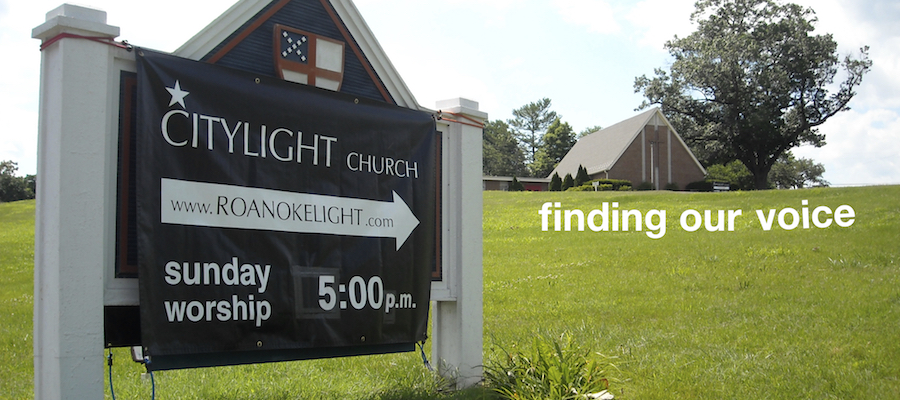
 St. Elizabeth’s Episcopal Church is a smaller church atop a grassy knoll across from a sports bar. Its sanctuary has blue-cushioned pews which seats perhaps 120. Its windows are stained glass with different depictions of Christ. Its outside garden has a statue of St. Francis of Assisi (to accompany their annual service of blessing for pets). They look to Elizabeth, the mother of John the Baptist, as their primary patron saint.
You may be wondering, “Derek, was this really the way to plant a church to reach those disconnected to church and distant to the faith?… Derek, are you okay with such religious icons?” Let me take these questions in order. The fallacy, I believe, among many church leaders is that younger people (dare I use generational labels such as “Millenials”) will only come back to church when church is remade in their culture. And so Gen X and Boomer leaders are tempted to “do church” as coffee bar, concert, and community program. Mega churches are able to rival the world in these, but this “relevance” is mere marketing if it supplants “the faith that was once for all delivered to the saints” (Jude 3). It is necessary to contextualize the faith with cultural understanding, but it is also imperative to contend for the faith against cultural underpinnings. All this to say, meeting in a traditional church with pews and stained glass windows was not a hinderance to church planting for us. Younger people desire authenticity and appreciate innovation. However, they also want the holy and the historic — something beyond themselves in the Story of God. That does not mean that I was now venerating religious icons and patron saints. Rather we just ignored these as we came into St. Elizabeth’s Episcopal Church that summer of 2008.
 For the next year, summer 2008 to summer 2009, Citylight gathered in this small church for Sunday afternoon worship and potluck dinner. Every week, I would drive my father-in-law’s ol’ Dodge Ram in hauling equipment the one mile between our home garage and St. E’s. We personalized the sanctuary with a projection screen and posters. Children’s ministry spaces were arranged for our babies, toddlers and younger kids. The kitchen and fellowship areas were readied for each week’s meal. There was soon a weekly rhythm of worship and community together. We were beginning to find our voice as a congregation — singing together, praying together, breaking bread together. I was just beginning to find my voice in pastoring and preaching.
I continued to put cards and posters around town, and some folks ventured to visit us after seeing these. We also began to have more relational invitations and word-of-mouth referrals. We were not launching large, but we were slowly growing one new friendship at a time. The church itself was a big small group, and so for weekly discipleship beyond Sunday, we started what we called “life groups”— gender specific groupings of three to four. This was a special time in simple beginning.
Here we were — a baby church in St. Elizabeth. Although we did not look to her as a patron saint, we did look to Scripture and considered the child she bore in her old age (Luke 1). This child, filled with the Holy Spirit, would grow to become a man who ministered by the river: “The voice of one crying in the wilderness: ‘Prepare the way of the Lord, make his paths straight'”(Luke 3:4). This was John the Baptist who declared of Jesus: “He must increase, but I must decrease” (John 3:30). This became an early prayer for myself and Citylight — that we would continually decrease even as we sought to grow as a church… that we would prepare the way for more people to know and follow Jesus.
In the summer 2009, because of a puppet musical of barnyard animals, an opportunity came for us to have a venue for Sunday morning worship. However, that’s a story for my next post.
HE>i, Derek Lam
